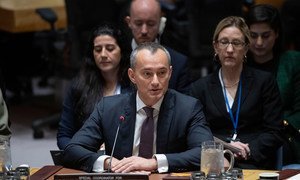
Nickolay Mladenov, UN Special Coordinator for the Middle East Peace Process and Personal Representative of the Secretary-General to the Palestine Liberation Organization and the Palestinian Authority, briefs Security Council members.
11 February 2020
Rising tensions and instability across the globe, particularly in the Middle East, underscore the need to resolve the decades-long conflict between Israelis and Palestinians, the UN Secretary-General told the Security Council on Tuesday.
António Guterres was delivering introductory remarks at an open briefing held just weeks after United States President Donald Trump announced a controversial peace plan for the region.
With the Palestinian President present in the Council chamber, together with Israel’s Ambassador, the UN chief reiterated the Organization’s continued support for a two-State solution: “This is a time for dialogue, for reconciliation, for reason”, he said.
“I urge Israeli and Palestinian leaders to demonstrate the necessary will required to advance the goal of a just and lasting peace, which the international community must support.”
Time to ‘move the process forward’: Mladenov
The US plan would legalize Israeli settlements in the West Bank and East Jerusalem and allow annexation of parts of the West Bank, while Jerusalem would remain the “undivided” capital of Israel, among other proposals.
The UN Special Coordinator for the Middle East Peace Process reported that it has been rejected by the Palestinian Government, the League of Arab States, the Organization of Islamic Cooperation and some members of the African Union.
"Today is the time to hear proposals on how to move the process forward”, said Nickolay Mladenov, “and to find our way back to a mutually agreed mediation framework that ensures meaningful negotiations can restart."
He added that there had been a violent reaction throughout the occupied West Bank and in Gaza shortly after it was unveiled.
“Just as unilateral steps will not resolve the conflict, those who reject the proposal should not turn to violence. That would be the worst possible response at this sensitive moment,” he said.
“Indeed, what is needed is political leadership and serious reflection on what needs to be done to bring the parties back to the negotiating table.”

Mahmoud Abbas, President of the State of Palestine, addresses the UN Security Council on the situation in the Middle East, including the Palestinian question.
Palestinian rejection
Palestinian President Mahmoud Abbas told the Council that the US plan will not bring peace or stability to the region as it annuls the legitimacy of Palestinians’ rights, including the right to self-determination.
It would also create a Palestinian State that would, in effect, look “like a Swiss cheese”, he added, with so many Israeli settlements remaining.
“I would like to reaffirm that this plan, or any part in this plan, should not be considered as an international reference for negotiations”, he said.
“This is an Israeli-American preemptive plan in order to put an end to the question of Palestine. It was rejected by us because it considers that East Jerusalem is no longer under the sovereignty of the State of Palestine: that alone is enough for us to reject this plan.”

Ambassador Danny Danon of Israel addresses the UN Security Council on the situation in the Middle East, including the Palestinian question.
Israeli backing
For Israeli ambassador Danny Danon, the US plan offers a “sane approach” to address the longstanding conflict, as all previous attempts have failed.
“What this plan does differently is refuse to accept the same out-of-date concepts of previous peace plans. This plan refuses to accept that the only way to solve the conflict is with a formula that has failed for over 70 years”, he said.
“The plan represents the requirement of a realistic approach that is not afraid to incorporate innovative ideas to address the concerns of both parties. It represents the necessity of a pragmatic approach in order to solve a complex problem.”
UN framework for negotiations
Mr. Mladenov, the UN envoy, expressed hope that ambassadors will support the Secretary-General’s call for a negotiated solution to the conflict and constructive engagement between the sides.
“There is no other framework except the one that Israelis and Palestinians together agree on, a framework based on relevant UN resolutions, international law and bilateral agreements,” he stated.
“In the absence of a credible path back to negotiations, we all face a heightened risk of violence. Violence, which will drag both peoples - and the region - into a spiral of escalation with no end in sight.”
Courtesy:UN News
Comments