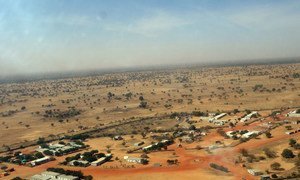
On 20 December 2018, UNAMID officially handed over the Mission’s team site in Graida, South Darfur, to the Government of Sudan as part its ongoing reconfiguration.
25 February 2019
Sudan’s President Omar Bashir may have declared a country-wide “cessation of hostilities” but in the face of continuing nationwide protests against his rule, the peace process in Darfur has “once again” come to a standstill, a senior UN official told the Security Council on Monday.
Assistant Secretary-General for Africa, Bintou Keita, was briefing members on the operation of the UN-African Union Hybrid Operation in Darfur (UNAMID), conceding that it has “yet to be assessed” how recent political developments in Khartoum will impact peace in the troubled Darfur region.
Against the backdrop of more than ten weeks of protests across Sudan against fuel and cash shortages, which threaten to bring an end to his 30-years in power, President Bashir declared a state of emergency on Friday.
The president reportedly sacked his vice-president after declaring the state of national emergency, adding those duties to the current defense minister’s portfolio. He also dissolved elected regional governments, replacing them with “18 new governors from the military and security apparatus”, Ms. Keita told the Council, adding that “the Sudan armed forces are tasked to deliver law and order, in addition to national defense”.
“These developments have come at a time when the Darfur peace process had come to a standstill – once again – in the context of the ongoing demonstrations against the economic and political conditions in Sudan”, she continued.
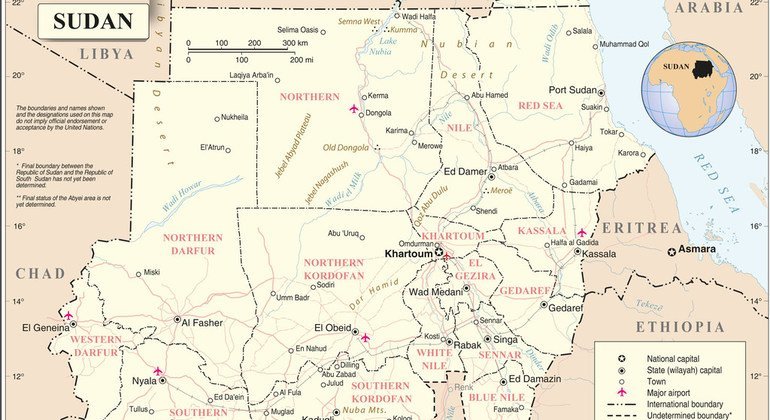
Map No. 4458 Rev.2, UNITED NATIONS March 2012.
To enlarge, click here.
The Mission was established in 2007, following a brutal civil war that broke out in 2003 that led to the deaths of tens of thousands of Darfuris and the displacement of nearly two million civilians, amidst allegations of ethnic cleansing of non-Arabs. During the fighting between Sudanese Government troops, militias and other armed rebel groups, widespread atrocities, including murder and rape, were reported.
At the end of last month, President Bashir declared an open-ended cessation of hostilities and 12 days later, government opposition factions extended for three more months a unilateral cessation of hostility in Darfur, Southern Kordofan and Blue Nile States.
“The impact of the recent developments in Khartoum on the dynamics related to the peace process in Darfur is yet to be assessed,” she explained, but the replacement of all civilian governors “will have a bearing on the process and some rebel groups have demonstrated a stiffening of their position”, she added.
On a recent fact-finding visit to Sudan, Ms. Keita met with internationally displaced persons (IDPs) who “all expressed their deep concern over the departure of UNAMID in the absence of trusted and professional law enforcement agencies.”
“Conflict-related sexual violence remains a threat to the population in Darfur, especially displaced women and girls who face particular risk when they engage in livelihood activities outside IDP camps,” stressed Ms. Keita. “The fear of sexual violence also hampers the return of civilians to their places of origin.
UNAMID and the UN Country Team (UNCT) are continuing to work together towards a smooth transition from peacekeeping in Darfur to sustainable peacebuilding, said Ms. Keita who added that new Mission Headquarters in Zalingei is now “fully operational” and the office of the Joint Special Representative has relocated to Khartoum.
Flagging the “considerable political, humanitarian, and peacekeeping investments” made by the UN, she spelled out that it was “our collective responsibility to ensure that the exit of UNAMID does not create a vacuum that leads to persistent local level tensions or new risk factors”.
On drawing down the Mission in less than two months, she said that international efforts should be made “in earnest” to mobilize the needed resources to support UNAMID’s exit “while focusing on a difficult economic and social and humanitarian context in the larger Sudan.”
Noting that there are still close to two million IDPs in Darfur, she emphasized that “human rights, issues, including the protection of women, children, and vulnerable youth from violence, remain significant,” and that the local capacity for rule of law needs strengthening.
Ms. Keita concluded by saying that “UNAMID will spare no efforts” in its focus on protecting civilians, human rights, rule of law, the humanitarian situation and disarmament.
Comments